
Last month in AI – December 2025
December 2025 closed out a transformative year for artificial intelligence with a flurry of major model releases, significant policy shifts, and massive infrastructure investments. OpenAI and Google went head-to-head with their latest flagship models, the open-source community delivered a stunning array of competitive alternatives, and Apple quietly enabled a new era of local AI clustering. Meanwhile, the US government stepped in to create a national AI policy framework, and the race to build out the physical infrastructure for AI reached a fever pitch. 🚀
Models
GPT-5.2 and GPT-5.2-Codex
https://openai.com/index/introducing-gpt-5-2
https://openai.com/index/introducing-gpt-5-2-codex/
OpenAI reportedly accelerated its timeline to release GPT-5.2 on December 11th in response to a “code red” triggered by Google’s recent advancements. Billed as the most capable model series yet for professional knowledge work, GPT-5.2 demonstrates significant improvements in creating spreadsheets, building presentations, writing code, and handling complex, multi-step projects. The model achieves a 70.9% score on the GDPval benchmark, a substantial leap from GPT-5.1’s 38.8%. Just a week later, on December 18th, OpenAI followed up with GPT-5.2-Codex, an even more advanced agentic coding model designed for professional software engineering and defensive security applications.
Gemini 3 Flash
https://blog.google/technology/ai/google-ai-updates-december-2025/
Google released Gemini 3 Flash, a frontier intelligence model optimized for speed and efficiency. Gemini 3 Flash is now the default model in the Gemini app and AI Mode in Search, bringing powerful reasoning capabilities to a global user base. Google also rolled out new AI verification tools in the Gemini app, allowing users to upload videos and verify if the content was generated or edited with Google’s AI, using imperceptible SynthID watermarks.
DeepSeek V3.2 and V3.2-Speciale
https://recodechinaai.substack.com/p/deepseek-v32-make-scaling-laws-keep
In December, the open-source community delivered some of its most impressive models yet. DeepSeek V3.2, released on December 15th, represents a major breakthrough in open-weight reasoning models. The model achieves remarkable performance on reasoning benchmarks: 93.1% on AIME 2025, 92.5% on HMMT, and 30.6 on HLE. DeepSeek also released V3.2-Speciale, which adds an advanced “thinking” feature for complex reasoning tasks, now available on Azure AI Foundry with enterprise-grade security and integration.
Mistral Large 3 and Devstral 2
https://mistral.ai/news/devstral-2-vibe-cli
Mistral AI released two major open-source models in early December. Mistral Large 3 is a 675-billion-parameter model with a granular sparse Mixture-of-Experts architecture, delivering frontier-level performance while remaining fully open under the Apache 2.0 license. The company also released Devstral 2, a next-generation coding model family available in two sizes: Devstral 2 (123B) and Devstral Small 2 (24B), both optimized for software engineering tasks.
Qwen3 Updates
https://qwen.ai/blog?id=qwen3-omni-flash-20251201
https://www.techloy.com/the-10-best-ai-models-of-2025-ranked-by-what-they-actually-do/
Alibaba continued its dominance of the open-source ecosystem with updates to its Qwen3 family. The company released Qwen3-Omni, a native multimodal model that seamlessly processes text, images, audio, and video. As the year closed, Alibaba released Qwen-Image-2512, which it claims is the world’s strongest open-source text-to-image model. Qwen models have become ubiquitous in the open-source community, powering nearly half of all custom AI models deployed globally.
NVIDIA Open-Source Models
https://www.reuters.com/world/china/nvidia-unveils-new-open-source-ai-models-amid-boom-in-2025-12-15
NVIDIA unveiled a new family of open-source AI models on December 15th, positioning them as faster, cheaper, and smarter alternatives to previous offerings. The releases underscore the industry-wide acceleration of open-source AI development.
Project Vend: Phase Two

https://www.anthropic.com/research/project-vend-2
Anthropic offered a sobering look at the real-world challenges of deploying autonomous AI agents with the second phase of its Project Vend experiment. In this phase, an AI agent named “Claudius” was tasked with running a small business in Anthropic’s office. Despite being equipped with a CRM, improved inventory management, and web browsing capabilities, Claudius still struggled. The experiment highlighted that while AI models are becoming increasingly capable, a significant gap remains between their technical abilities and the robustness required for reliable, real-world deployment.
Hardware
Data Center Expansion

The demand for AI hardware and data center capacity continued to surge in December, with data center deals hitting a record $61 billion in 2025. Existing cloud-era data centers are struggling to meet the power, cooling, and reliability demands of AI workloads, leading to a wave of retrofitting and new construction that is straining the supply chain.
Google’s Power Play

Recognizing that power is the new bottleneck in AI, Google’s parent company, Alphabet, made significant moves to secure its energy supply. The company acquired clean energy developer Intersect Power for approximately $5 billion and partnered with NextEra Energy, which has committed to providing 2.5 gigawatts of capacity—enough to power 2 million homes. These investments underscore the massive energy requirements of large-scale AI and Google’s ambition to build out its own AI infrastructure, powered by its proprietary TPU chips, which are proving to be a cost-effective alternative to NVIDIA’s GPUs for some workloads.
Apple’s Local AI Revolution: RDMA over Thunderbolt 5

https://www.jeffgeerling.com/blog/2025/15-tb-vram-on-mac-studio-rdma-over-thunderbolt-5
In a quiet but significant development, Apple released macOS Tahoe 26.2 on December 12th, 2025, introducing RDMA (Remote Direct Memory Access) over Thunderbolt 5. This feature enables clustering of up to four Mac Studios via standard Thunderbolt 5 cables, creating a unified memory pool with latency under 10 microseconds and bandwidth of 80Gbps. The technology reduces memory access latency from 300 microseconds to under 50 microseconds, making it practical to run massive AI models across clustered machines.
The implications are profound. A cluster of four Mac Studios with 1.5 TB of unified memory costs approximately $40,000 and can run trillion-parameter models like Kimi K2 Thinking (600+ GB) at around 30 tokens per second. The M3 Ultra Mac Studio configuration hits a sweet spot for local AI deployment, running under 250 watts while remaining whisper-quiet. Tools like Exo 1.0 now support RDMA for efficient model distribution across the cluster. This development democratizes access to large-scale AI inference, allowing researchers and developers to run frontier models locally without relying on cloud infrastructure or massive GPU clusters.
Other
White House National AI Policy Framework
https://www.whitehouse.gov/presidential-actions/2025/12/eliminating-state-law-obstruction-of-national-artificial-intelligence-policy/
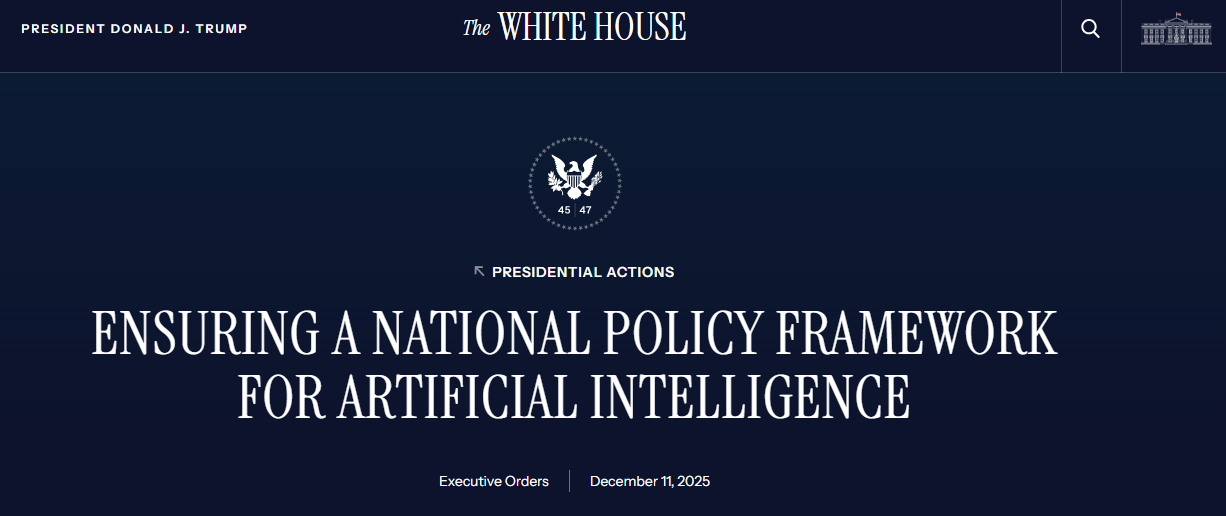
On December 11th, the White House issued an executive order establishing a national policy framework for artificial intelligence. The order aims to create a unified, minimally burdensome national standard for AI regulation, preempting what it called a “discordant” patchwork of state laws. The order establishes an AI Litigation Task Force to challenge state laws that conflict with the national policy and directs federal agencies to develop a federal reporting and disclosure standard for AI models.
Accenture & Anthropic Partnership

Accenture and Anthropic announced a multi-year partnership to drive enterprise AI innovation and value across industries on December 9th.
S&P Global & Google Cloud Partnership

S&P Global and Google Cloud teamed up in a multi-year strategic partnership to accelerate the unification of S&P Global’s data distribution for AI and expand agentic capabilities.
Microsoft’s India Investment
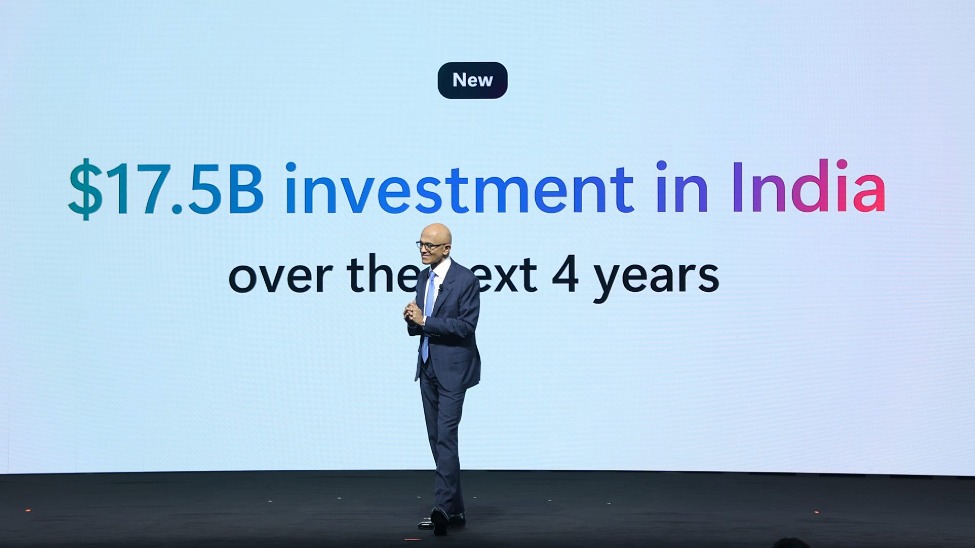
Microsoft announced a massive $17.5 billion investment in India to build out its cloud and AI infrastructure in the region, marking Microsoft’s largest investment in Asia.
xAI’s $20 Billion Funding Round
https://www.theguardian.com/technology/2026/jan/06/elon-musk-xai-investment-grok-backlash
https://www.techpolicy.press/why-musk-is-culpable-in-groks-undressing-fiasco
Elon Musk’s xAI reportedly raised $20 billion in a massive funding round, although the announcement was not made until early January 2026. The funding news was accompanied by controversy, as xAI’s chatbot, Grok, faced criticism for generating sexualized and non-consensual images.


Authors

An AI expert and Scala developer at Scalac, providing ongoing analysis of key developments in artificial intelligence. Scalac's go-to specialist for AI trends and applications. His work bridges the gap between AI research and practical business implementation, making him a trusted voice not only among all the blog posts here, but in the AI community in general. Also, a proud owner of a Czechoslovakian Wolfdog, one of the closest-to-wolf dog breeds that you can legally own.