This site uses Cookies. Read privacy policy.

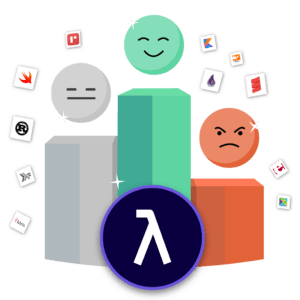
The only ranking on the web, based on sentiment, not popularity. Find out which functional language is loved and which gathers the most negative feedback.

This ranking is the first update of the Functional Programming Languages Sentiment Ranking published in April 2021.
The sentiment analysis mechanism behind the ranking is based on the most popular achievements related to artificial intelligence – i.e., deep learning networks and embedding.
We’ve been gathering data for 3 months and have analyzed 160,556 mentions, which have given us insights into 14 functional programming languages (2 more languages than in the previous edition of the ranking). We have aggregated them using the sentiment analysis feature in Brand24.


That’s what Percent’s Divisons head thinks about our 2 yeats of work. Need a development partner? Let’s have a free and confidential chat.


“They were able to quickly become acquainted with highly complex requirements and always delivered on time.”
AI agents pushed GitHub to 275 million commits a week, and Microsoft's own cloud couldn't keep up. Microsoft and JetBrains just placed opposite bets on who should own the harness your coding agents run in.
What we learned building a Rust orchestration layer for a real multi-agent AI system — from A2A protocol churn and manual agent loops to Agent Skills and context design.
AI agents fail at system boundaries, not in prompts. Here's where Scala's type safety helps when LLM pipelines move from prototype to production.
Founder & Instructor at Rock The JVM